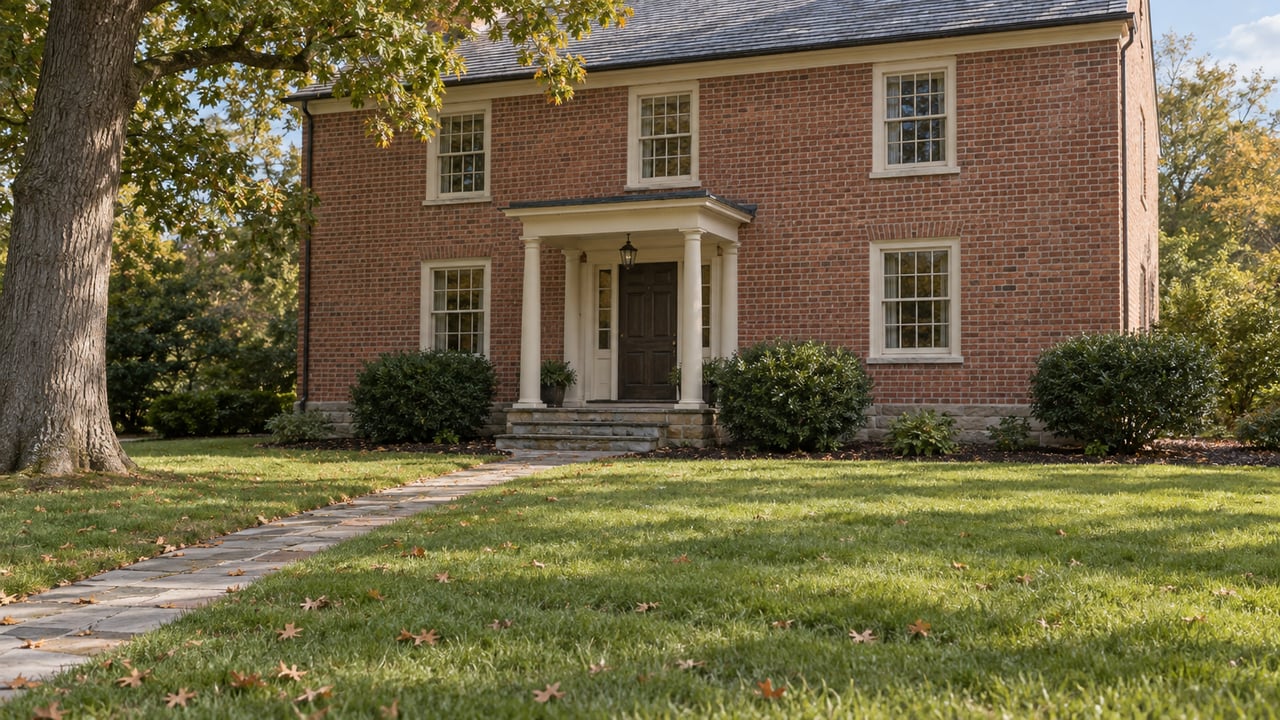
The 2026 Starter and Silver Homes Act: What It Could Have Meant for Chevy Chase Lots
October 1, 2026
October 1, 2026
If you toured a home on a quarter acre in the Town of Chevy Chase, Chevy Chase Village, or Chevy Chase View this spring, you were pricing in something you probably never thought to ask about: whether the lot next door could legally become three lots. For most of this year's legislative session, that question had a real answer, and it wasn't the one buyers assumed.
In January, Governor Wes Moore's administration introduced the Starter and Silver Homes Act of 2026, a bill built to loosen local zoning statewide and let more small, affordable homes get built. Maryland Housing Secretary Jake Day framed it as a fix for a state where too many young families and older residents have run out of housing options. The Delmarva Times reported that the bill applied to charter counties, Montgomery County among them.
The Starter and Silver Homes Act wasn't a suggestion to counties. It was a set of hard prohibitions on what local zoning could require. Specifically, it would have stopped Montgomery County and its municipalities from enforcing:
It also would have given owners of an improved lot the right to subdivide it into as many as three smaller lots, as long as the new lots followed other local rules. Minimum lot sizes in legacy Montgomery County neighborhoods commonly run from 7,500 square feet up toward 20,000 or more. A 5,000 square foot floor would have been a real cut, not a technical one.
For a place like the Town of Chevy Chase, this wasn't abstract. The town's own land use guide walks residents through a mandatory pre-permit meeting, called a Pre-PAC, for any addition over 500 square feet or any demolition of more than half a home's exterior walls. Neighbors are invited. Staff review the design. That entire process exists because the town currently has the authority to regulate how a new or renovated home looks next to the ones around it.
The pushback wasn't organized by a single advocacy group. Chevy Chase View's Town Council joined eleven neighboring municipalities in a joint letter sent directly to the chairs and vice chairs of the Senate Education, Energy, and the Environment Committee and the House Economic Matters Committee, the two panels holding hearings on the bill. The Citizens Coordinating Committee for Friendship Heights ran its own campaign, asking residents to sign and submit testimony ahead of the House hearing on February 12 and the Senate hearing on February 17. Montgomery County Planning Department staff, including planner Lisa Govoni, presented an analysis to the Maryland-National Capital Park and Planning Commission, which took its own position on the bill.
The argument that carried the most weight in committee wasn't really about lot sizes. It was about who gets to decide. The Baltimore Banner reported that Senator Jason Gallion, a Republican representing Cecil and Harford counties, put the tension directly to Secretary Day during one hearing:
"Why should the state override local governments?"
Day's answer leaned on polling showing broad statewide support for more housing, not a defense of any specific lot in Montgomery County. That gap, between a state-level affordability argument and a hyper-local zoning fight, is what stalled the bill.
Crossover Day, the Maryland General Assembly's internal deadline for a bill to clear its chamber of origin, fell on March 23, 2026. Neither SB 36 nor HB 239 made it out of committee by then. The Baltimore Banner's reporting in April confirmed the outcome for the broader package: two of Moore's three housing bills moved through the session without much resistance, while the most ambitious one, the Starter and Silver Homes Act, stalled out entirely.
Chevy Chase View's town government posted the clearest read of what that actually means for residents. The bill wasn't withdrawn. It wasn't voted down on the merits. It simply ran out of legislative clock, and the town's own notice to residents states plainly that the bills have not been formally withdrawn and may be reconsidered in a future session, 2027 or later.
That distinction matters more than it sounds like it should. A bill that fails a floor vote tends to signal that the idea lacks support. A bill that dies at a procedural deadline after drawing a coordinated twelve-municipality opposition campaign signals something closer to a fight that was postponed, not settled.
Part of what a buyer pays for in Chevy Chase is the house. Part of it is the lot, and part of the lot's value is the assumption that its size, its setbacks, and the design review governing what gets built on it will still be true in ten years. That assumption held in 2026, but it held by a legislative calendar running out, not by the idea losing.
For a straightforward move-up buyer planning to live in the home for the next decade, this is background information worth knowing rather than something to act on. Zoning that survives one session tends to survive the next, and Montgomery County's municipalities have now shown they can mobilize fast when a similar bill reappears.
For anyone treating a Chevy Chase property as a long-hold investment, a teardown-and-rebuild project, or a second home meant to appreciate on land value as much as the structure, the calculus is different. The premium on a large, well-situated lot in these towns has always priced in some assumption of permanence. This year showed that permanence has a political cost, one that has to be renewed, not just assumed. If the Starter and Silver Homes Act or something like it returns in 2027 and clears committee before a similar coalition can organize against it, the zoning protections underneath that premium change, not the house itself.
None of this is a reason to avoid Chevy Chase. It's a reason to understand what you're actually buying when you pay for the lot and not just the square footage inside it.
Does this affect homes that are already built? The bill governed what local zoning could require going forward, including subdivision rights on improved lots.
When would the bill have taken effect? The bill as written would have taken effect October 1, 2026 had it passed.
Should a buyer wait for the 2027 session to resolve before purchasing a large lot in Chevy Chase? That's a personal risk tolerance question more than a market timing one. The 2026 fight showed local opposition can be fast and organized, which is itself useful information for anyone weighing how durable these protections are likely to be.
If you're weighing a purchase in Chevy Chase, or trying to figure out what a large lot's price actually reflects beyond the house sitting on it, I'm glad to walk through what I'm seeing on the ground. Let's Connect.
This article is general information, not legal, tax or financial advice. Consult a qualified professional about your situation.
Stay up to date on the latest real estate trends.

With Eva, real estate is more than a transaction—it’s about building long-term relationships, creating opportunities, and helping people achieve their version of the American Dream.